Quick answer: A DSM-5 cheat sheet PDF is a short reference that summarizes the most common DSM-5-TR diagnoses, their key symptoms, and how long symptoms must last, so clinicians can check a diagnosis without searching the full manual. My 10-page DSM-5 Cheat Sheet PDF covers 20+ common diagnoses using the FIDO method (Frequency, Intensity, Duration, Onset) and costs $9.
Written by Manicka Thomas, LISW-S, a licensed independent social worker and clinical supervisor with more than 15 years of experience in social work and behavioral health leadership.
As a licensed independent social worker and clinical supervisor (LISW-S), I know how much time diagnosis can take when you’re flipping through a 1,000-page manual between sessions. That’s why a DSM-5 cheat sheet PDF has become one of the most useful tools in my practice. It puts the most important diagnostic information on a few pages so you can work faster and feel more confident.
In this post, I’ll walk you through what the DSM-5-TR is, what a cheat sheet should include, how to use one the right way, and where to get the one I created for social workers and therapists.
What Is the DSM-5-TR?
The DSM-5-TR is the Diagnostic and Statistical Manual of Mental Disorders, Fifth Edition, Text Revision, published by the American Psychiatric Association in 2022. It’s the guide psychiatrists, psychologists, social workers, counselors, and other mental health professionals use to diagnose mental health conditions such as depression, anxiety, PTSD, bipolar disorder, and schizophrenia.
The manual groups conditions into categories and lists the criteria for each one. For example, a diagnosis of major depressive disorder requires a specific number of symptoms, such as depressed mood or loss of interest, present over a set period of time. Once you have a diagnosis, you can build a treatment plan that may include therapy, medication, lifestyle changes, or a combination.
The text revision updated descriptions throughout the manual and added prolonged grief disorder as a new diagnosis. Mental health is a complex field, and the DSM will keep changing as research grows, so it’s important to stay current.
What Is a DSM-5 Cheat Sheet PDF?
Sometimes you need a quick summary instead of the full manual. A DSM-5 cheat sheet PDF is a simplified guide that pulls together the information you reach for most often: common diagnoses, key symptoms, and how long symptoms need to last.
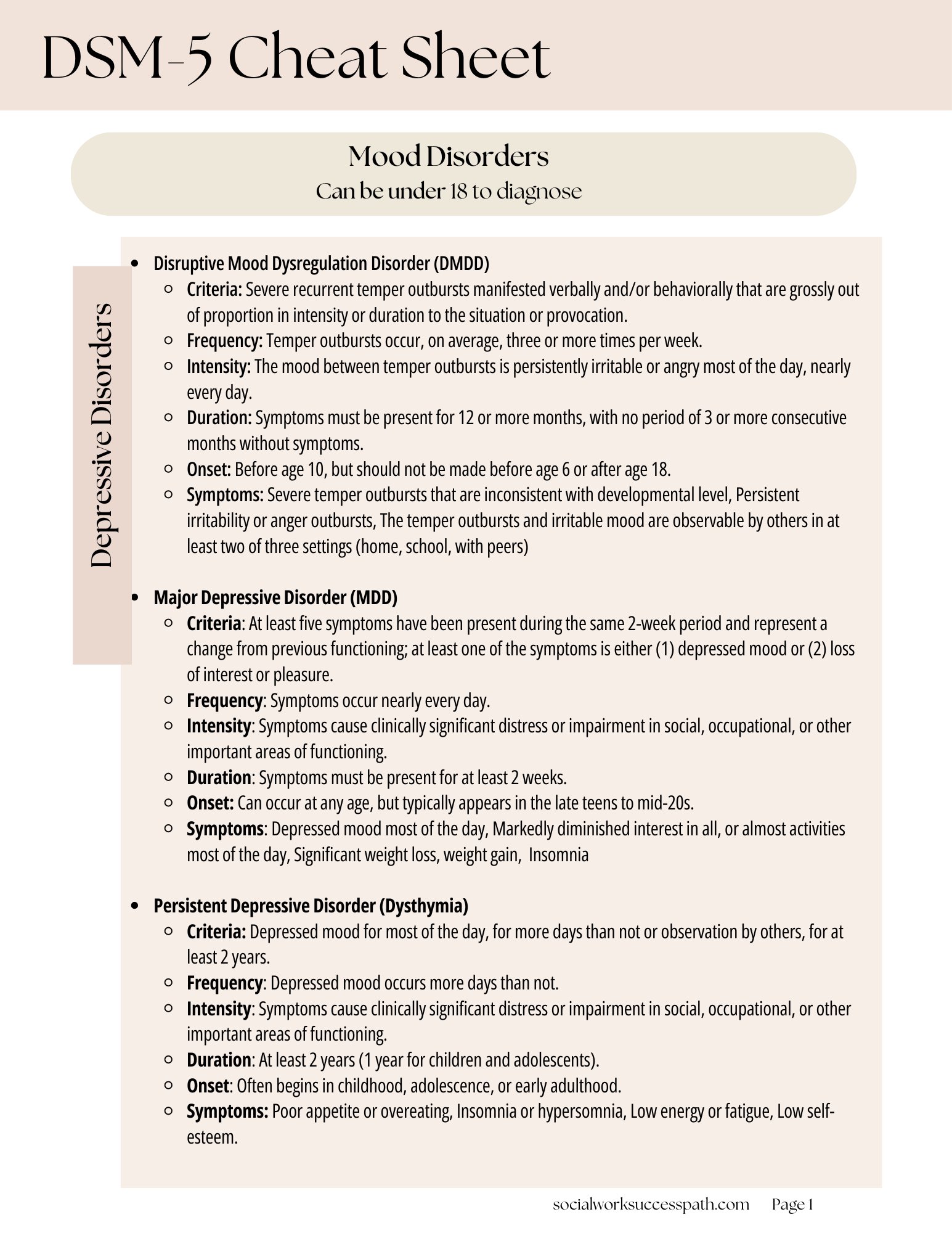
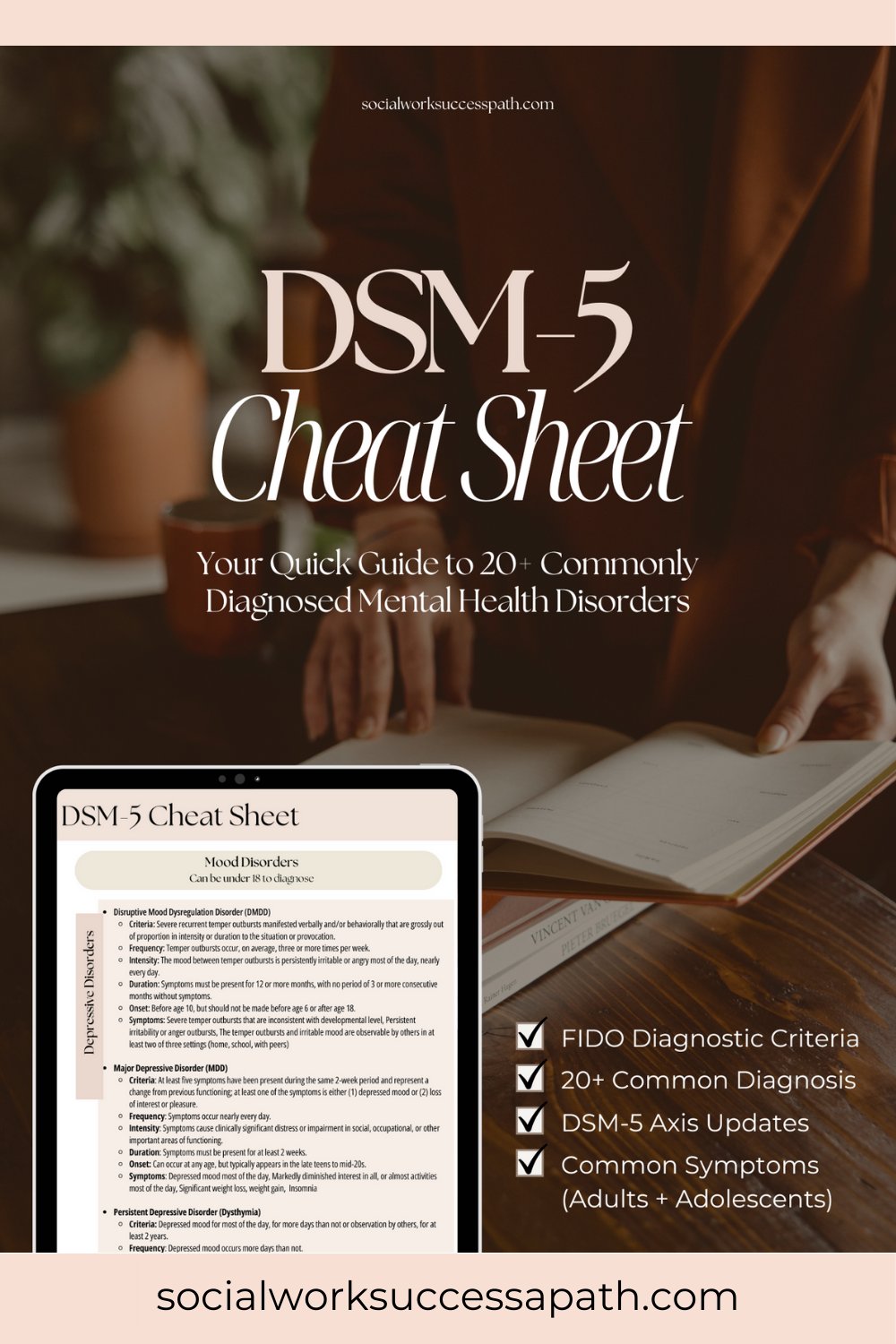
I created my DSM-5 Cheat Sheet PDF for social workers and therapists who want that information organized in one place. It’s a 10-page guide to more than 20 commonly diagnosed mental health disorders, organized by category, including:
- FIDO diagnostic criteria: the Frequency, Intensity, Duration, and Onset for each diagnosis
- 20+ common diagnoses across depressive, bipolar, anxiety, trauma, neurodevelopmental, behavior, and personality disorders
- Common symptoms for adults and adolescents
- Notes on how the DSM-5 changed diagnosis, including the move away from the old multiaxial (Axis I–V) system
How Many Disorders Are in the DSM-5?
The DSM-5-TR describes roughly 300 conditions, from common ones like depression and anxiety to rare disorders. They’re grouped into about 20 diagnostic categories based on shared symptoms and characteristics. Some of the main categories are:
- Neurodevelopmental disorders
- Schizophrenia spectrum and other psychotic disorders
- Bipolar and related disorders
- Depressive disorders
- Anxiety disorders
- Trauma- and stressor-related disorders
- Feeding and eating disorders
- Sleep-wake disorders
- Personality disorders
- Substance-related and addictive disorders
Other DSM-5 Quick References Worth Having
If you want something printed for your desk or bag, these are two well-known options from the American Psychiatric Association’s publishing arm:
- Desk Reference to the Diagnostic Criteria From DSM-5-TR: a compact version of the diagnostic criteria, without the long text descriptions.
- The Pocket Guide to the DSM-5-TR Diagnostic Exam: a practical guide to conducting a diagnostic interview, which is helpful for newer clinicians.
6 Tips for Using a DSM-5 Cheat Sheet Effectively
1. Get familiar with the layout
Spend a few minutes learning how your cheat sheet is organized, so you can find a category, its key symptoms, and its duration requirements quickly.
2. Keep it close
Keep it where you can reach it during assessments, consultations, and treatment planning, whether that’s printed on your desk or saved on your tablet.
3. Use it as a quick reference
When a client’s symptoms point toward a particular disorder, use the cheat sheet to check your thinking and guide your next questions.
4. Double-check the diagnosis in the full manual
A cheat sheet is a summary. Before you finalize a diagnosis, especially a complex one, confirm the full criteria, specifiers, and exclusions in the DSM-5-TR.
5. Trust your clinical judgment
Your clinical experience matters as much as any reference tool. Not every client fits neatly into a category, so use the cheat sheet as a guide, not a rulebook, and consider culture, context, and history.
6. Stay updated
The DSM keeps evolving. Watch for revisions so the references you rely on stay accurate.
You may also like: 6 Self-Care Strategies for Social Workers and Mental Health Private Practice
Conclusion
A DSM-5 cheat sheet PDF turns a very long manual into an easy-to-use reference, so you can assess clients faster and feel more confident about your diagnoses. If you want one built specifically for social workers and therapists, grab my 10-page DSM-5 Cheat Sheet PDF below.
FAQs
What are the DSM-5-TR criteria?
They’re the specific guidelines in the DSM-5-TR that mental health professionals use to diagnose and classify mental health disorders, based on which symptoms are present and how long they’ve lasted.
Is the DSM-5-TR a good diagnostic tool?
Yes. It’s the standard diagnostic reference for mental health professionals in the United States, and it’s used for diagnosis, treatment planning, research, and insurance billing.
What are the codes in the DSM-5?
Each diagnosis has an alphanumeric code that matches the ICD-10-CM system. Clinicians use these codes for billing and for clear communication and documentation across healthcare settings.
Does the DSM-5 still use axes?
No. The DSM-5 removed the five-axis system used in the DSM-IV. Clinical disorders, personality disorders, and medical conditions are now listed together, and psychosocial and contextual factors are noted separately.